Wednesday, June 30, 2010

Larger Than Life

As I mentioned in my last entry, I did not photograph Irving Porter because of his poor health. I just received this photo of Irving and his daughter Cindy, that was taken in the late 1950’s. It appears that the photo may have been cropped but I think that that there is enough of it there for you to agree that Irving was the real thing. Hollywood would be hard pressed to outfit an actor that would project a stronger impression of a cowboy in the West.

Post edit:
I regret to report that Irving porter has passed away. Here’s an excerpt from the Alamogordo news paper:
Don Irving Porter, 85, passed from this life on Saturday, Sept. 18, 2010, at his home in Piñon.
I am glad I had a chance to visit with this fine man.

Post Edit 5 months later:

Lessie (Smith) Porter passed from this life Friday, Feb. 25, 2011, at
her home in Piñon.
She was born to Alva and Ethel (West) Smith on July 2, 1926, in Artesia. She was a lifelong resident of the Piñon area. She attended elementary school at Bonita School, high school at Weed and college at Eastern New Mexico University in Portales.
In 1948 Lessie married Irving Porter in Alamogordo. They lived on ranches their entire married life of 62 years. She was caregiver to Irving at their home for the last year of his life.

Tuesday, June 22, 2010

On the Trail of a Legend

We often hear or say things like, “the movie just wasn’t like the book”, or, “the book wasn’t as good as the movie”. When commenting on a work based on a real person or happening there are also conflicts between realty and journalism. For some of us it is not enough to just speculate about what really happened People like me feel compelled to delve into the history of the story. We seek out those who have first hand knowledge of the incidents and people depicted in literature or cinema. There are some who lean the other way and view movies as documentaries rather than entertainment.


When Bill Key and I read Fire on the Mountain, by Edward Abbey, we vaguely recalled the movie. We then began to recall stories of the real life circumstances that inspired the novel. It is the story of a rancher who is told that he must leave his land behind and move on because the US Army needs his ranch for the expansion of White Sands Missile Range. The rancher was named John Prather and he raised mules for the Army on the Otero Mesa. He told the officials that he wasn’t going to leave and would spend the rest of his life on his ranch.

Bill and I knew that the book was based on real people and events so we set out to meet anyone who had direct contact with the characters mentioned in the book. Our research led us to the remote home of Irving Porter in the southern New Mexico mountains. In Abbey’s book the character Billy, was based on Irving. We also met Arleen Gaba and her son Mike Gaba. Arleen’s husband was Prather’s grandson and the Gabas lived on the ranch with “Grandpa” Prather. Arleen wrote an article called Five Years with the Mule King for Range Magazine. Her story is about the conflict between Prather and the US Government.

During our visit with Mike and Arleen they gave Bill a stack of photographs. The images are of family members and some even show Army personnel at the ranch. Mike, who continues to research his family history, gave Bill permission to use the photos in a magazine article.

The most interesting part of the whole trip was listening to Mr. Porter tell his about what really happened out there on the ranch. There is a lot more to the stories than a conflict with the US Army. For example; at one time, in the early 1930’s, Prather had agreed to sell mules to the Mexican Army. This meant that he had to drive the mules eighty miles to the Santa Fe Street Bridge in El Paso. After the three day trip Prather met the Mexicans half way across the bridge to complete the transaction. Prather did not speak Spanish and for some reason suspected that the Mexican officer was trying to get the best of him. One of Prather’s men finally stepped forward to do some translating. The Mexican leader then got down off of his horse and emptied a bag of money out on the bridge. After Prather was satisfied that all of the money was there the deal was done and the groups parted ways without further dialogue.

Another interesting fact was brought to light when talking to the Porters and the Gabas. Edward Abbey never interviewed Prather or any of the people that and first hand knowledge of what really went on. He just followed the news and let the his imagination run with the story. So there is reality, the book, and the movie. Unfortunately too many  folks just accept what they see on a movie screen, or television, as history. Then they go on making real life decisions based false history.

The trip was fun and we met some great folks. I took a few pictures while we were visiting the Porters; the first photo shows Bill flirting with Lessie Porter. The second is me making friends with a corgi named Moose. Moose is in charge of ranch security these days.

 In order to preserve Mr. Porter's dignity, I chose not to photograph him in a state of bad health.

By the way, Kirk Douglas was the star of the movie Lonely are the Brave, which was based on Abbey’s novel called The Brave Cowboy. Douglas says this was his favorite motion picture. If you are interested, here is a link to a multi part interview of Douglas discussing the movie: http://www.youtube.com/watch?v=onzqlL3rey8

Monday, May 3, 2010

Interest Piqued too Soon on New Firearms

Interest Piqued too Soon on New Firearms

I just thought that I would pass on a little bit of info about a new model of pistol and its availability. A friend got a new Guns and Ammo magazine that features a new .380 caliber pistol. It is the Sig-Sauer 238. The magazine shows the same gun in about a dozen different configurations. The colors, weights, metallurgy, and furniture (grips and accessories like rails for lasers etc.) vary from model to model. My friend is all hot to get his paws on one and is serious about making a purchase.

The same sort of manufacturing deficiencies appear to be happening that occurred with the .327 Federal. Academy, Cabela’s, and online distributors don’t have any. They can only get a couple each week because the big distributors can’t get any from the manufacturers.

This method of marketing is the opposite of any sales techniques I’ve ever read about. All the hype has the dealers and consumers buzzing with anticipation but there is no product to sale. I have always thought that the idea was to strike while the iron is hot. The way they drag it out, half the people who want to buy one now, will have cooled off before they can make a purchase.

Another friend felt the same way about the .327 Federal when he read about it. He was ready to shell out for it just a few months ago but now the desire to buy is gone. Oh well, a lot of things don’t make sense to me but some things seem down right stupid.

Tuesday, April 6, 2010

Men Who Get High With Goats

 My next adventure in Egypt was to help my friend, Bill Key, get some photos for an article he is writing. It is about an aqueduct, shown in the first picture, which was built in the sixteenth century. In its time, Borg El-Sakkiyat played a major role in delivering water to certain parts of Cairo. Its tall pumping station, powered by oxen, lifted water from the Nile so it could flow down a gentle slope to various points of distribution.

 This once magnificent structure has been all but consumed by the infrastructure of Cairo. The exhaust from millions of motor vehicles has coated the stone blocks and mortar to form a dark gray patina that camouflages the structure. I would dare to say that the two kilometer stretch of this medieval aqueduct along a main thoroughfare goes virtually unnoticed by most people that pass by it.

 In order to get the best photos, Bill and I knew that we needed to get on top of one of the nearby buildings. The second picture shows a view of a hospital. The yellow building to its left is a girls school.. We were discouraged from entering the hospital by the general lack of organization and funk that met us at the door. We were forbidden from entering the girls’ school by an irate lady that glared at us two gringos like we were invaders from mars. Finally we gained permission the go on top of an apartment building, shown in the third photo.

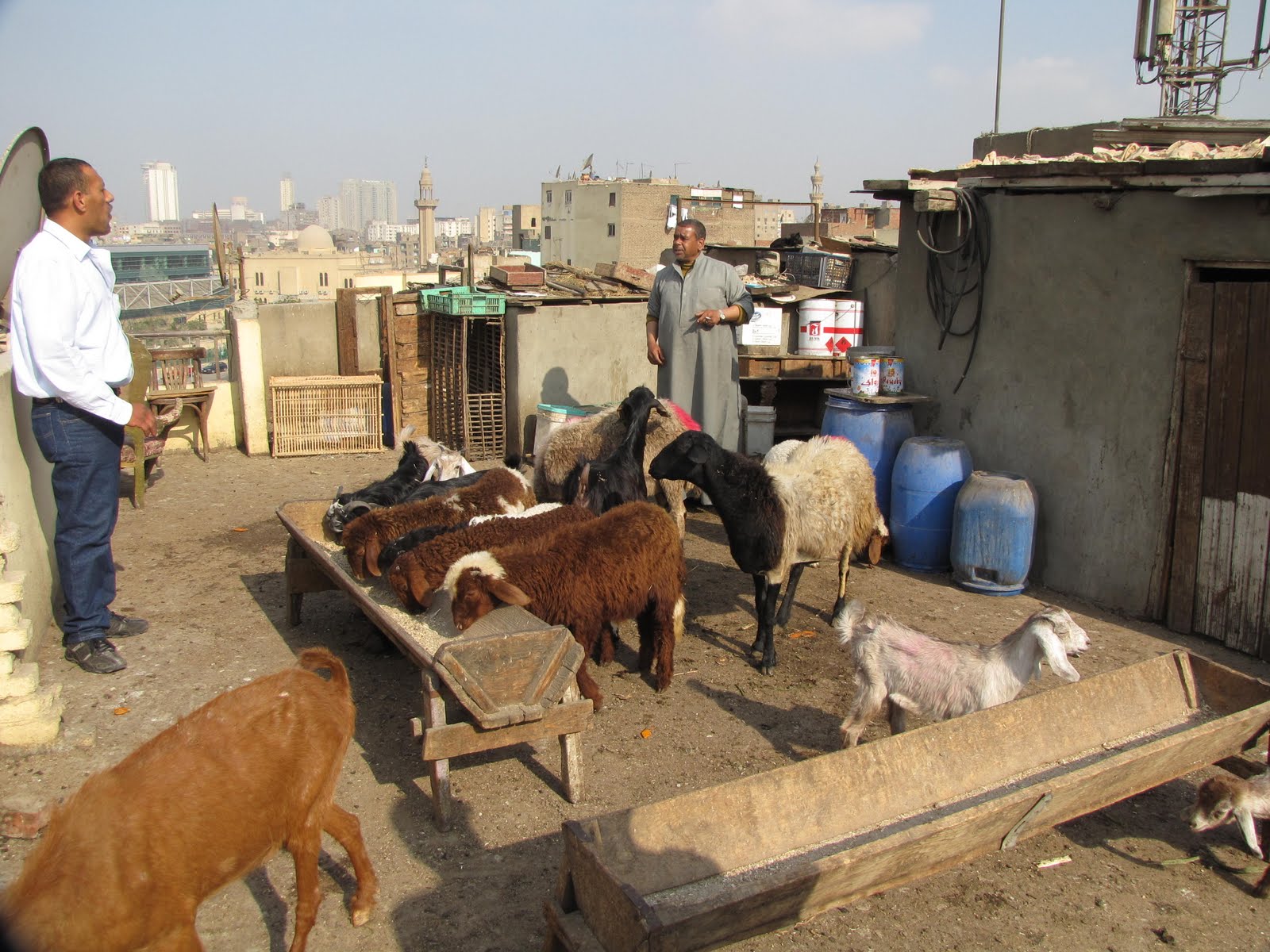
 While climbing the stairs we began to notice, near the top of the staircase, that alfalfa, carrots, and other vegetable scraps were lying to the side of the stairs. Finally, we saw sunlight and as we stepped out on the roof we were surprised by the presence of about a dozen goats and a couple dozen small ducks. The roof had  a four foot parapet wall around the perimeter that served as a fence to keep these critters from falling to the street below. The parapet also served useful to me as a place to steady my camera while photographing the aqueduct.

After the photos were done we took a few minutes to visit with the roof top rancher. Bill and our friend Mahmud speak Arabic so we were able to find out that the owners mother had made the Hajj, or pilgrimage to Mecca. She was quite proud of her accomplishment which earned her a special place in the Muslim community.

After we went back down on the street, Bill and I walked the entire length of the aqueduct. Money had been recently appropriated for some repairs on the 500 year old structure and we saw several workers digging near some of the arches. The purpose of the excavation is to dig down far enough that the footings can be reinforced. The piles of dirt and debris being removed from the ground contained a few interesting artifacts such as glazed tiles. These tiles were probably part of a paved walk way at one time.


At the far end of the aqueduct lies the ancient pumping station which is shown in the last photo.

Sunday, February 28, 2010

Gringo in the Sahara : A Developing Story

 After a long trip from Texas I found myself in the midst of more people and noise than I could have ever imagined. Thankfully I was able to rest and recuperate from simple exhaustion and dehydration in the comfortable home of my friends Bill and Kathleen Key. Their large fifth story apartment is located in Maadi, one of the nicer areas of Cairo.

 The balcony over looks the Nile and on a clear day one can view several pyramids and gaze down upon an endless, honking stream of traffic on the street below. Some how these motorists maintain three to four rows of traffic on a street marked for two lanes.I decided that the white lines merely indicate the direction of the traffic flow. As long as car is not perpendicular to the lines then all is well. Stopping and backing up, when the vehicles are moving with their bumpers nearly touching, is not an unusual maneuver. Plenty of shouting and hand gestures go on during these automotive antics, however a delicate balance exists which allows life to go on from day to day. It doesn't appear that it would take much upset that balance and for chaos to begin to rule the streets.
 Sparsely scattered among the many Mosques are Coptic Christian churches which are a reminder of Mary and Joseph’s flight to Egypt with baby Jesus. One island in the Nile close to central Cairo, known as the Island of Gold, is graced at one end with a Christian Church displaying a cross on its tall spire. At the other end of the Island is a Mosque with the iconic crescent moon resting at the top of a slender tower used by an appointed man who starts the prayer chanting at the appropriate times.

 Despite the western assumption that Christians and Muslims can't live together, the people of Cairo are surprisingly friendly to one another and westerners (khawagas) such as me.

 I quickly found my self comfortable in situations that I planned to avoid. I think that the realization that I was walking the same streets once walked by Jesus and the courage I gained from prayer put me at ease.
The day after I arrived in Cairo my expatriate friends and I loaded our gear into two four wheel drive vehicles and started a nine hour journey to an oasis village named Siwa. The desert along the Mediterranean coast imparts deceptive impressions to the eye. An endless sea of sand subtly merges with the sea while intense sunlight makes it difficult to judge distances.

Oh!

All I see turns to brown
As the sun burns the ground.
And my eyes fill with sand
As I scan this wasted land.
Tryin' to find
Tryin' to find
Where I've been.

KASHMIR, Led Zepplin

After hours of travel across the harsh terrain of the Sahara, about 30 miles east of the Libiyan border, palm trees start to become visible. In very little time from first sight of the green spot on the horizon, you find yourself in the midst of a city full of friendly people. The precious water from the artesian wells throughout Siwa is used to irrigate hundreds of acres of gardens.

The hotel where we stayed  is ancient and had been retrofitted with plumbing and electricity so; it was a comfortable place when compared with the primitive homes in the area.

 The next morning we rented donkeys and carts and from the hotel we headed to a hill covered with the remains of a small community. At the base of the hill stands a bronze plaque that identifies the spot as the location of The Temple of the Oracle. Alexander the Great stopped here prior to his conquest of Egypt and the oracle confirmed him as both a divine personage and a legitimate Pharaoh of Egypt. That was in 351 BC.

 I was astounded by the fact that the ruins here were being left to disintegrate in the desert sun. The hill was unattended and we had free rein to explore as much as we wanted to. Attached are photos of me driving my donkey cart, a view of the hill from a distance, and me again, at the entrance to the Temple of the Oracle.

 The next day our little caravan headed back to Cairo. On the way we made a stop at the El Almein Battleground Memorial. During WWII the Germans attempted to stop the flow of supplies going through the Suez Canal to Allied countries in Europe. The Allied forces were able to drive the Germans out of Egypt but they paid a high price for the victory. The cemetery where the casualties were laid to rest had an aura about it that caused me to become very reflective and emotional about that terrible war. All wars are terrible but due to the fact that the world is full of power hungry people that want to rule the world wars have been necessary throughout the history of our country to preserve our freedom. WWII has a special place in the history of the United States in that it was the last war that was fought by military professionals focused on victory. All of our wars since then have been orchestrated by politicians focused on their own personal gain.


 While I am on the subject of the policies of national security and defense of our freedom, I would like to share an observation that I made while traveling abroad. In Europe, Africa, and the Middle East airport security is conducted in more effective manner than in the US. While profiling is discouraged in our country, it is the foundation of the procedures used in the rest of the world. Unfortunately, idealistic groups like the ACLU have taken away the basic tools needed for making our airlines as safe as they could be. The same can be said about our immigration laws. The doors are open for our worst enemies to enter our homeland and set up shop to work toward destroying us.

Our founding fathers had Christian values and common sense to guide their tongues and pens. Unfortunately too few people today understand history and human nature enough to make rational plans for our future. Of the few that are grounded in the traits needed to lead us into the future, too few have the courage to speak, let alone act on their beliefs. There are many politicians that have there heads in the clouds and their hands on their wallets instead of their hearts.


Monday, February 15, 2010

Headed to Cairo


I am headed to Cairo tomorrow. I think that there will be a lot to tell about when I get back. I will keep you posted.

Friday, February 12, 2010

Climate Change

Last night, before I went to bed, I stepped out back and took this picture. George Bush caused the power to go off so Al (Greenhouse) Gore sent all those white globular objects to warm us up.